MaidsMe was the project where my hardest problems stopped being technical. The limo plugin taught me debugging, payments, and timing rules. This one taught me judgment, when to tear down working code, which friction to keep on purpose, and how architecture carries ethics. This finale is the honest accounting of what got built and what it changed in how I build.
What actually got built
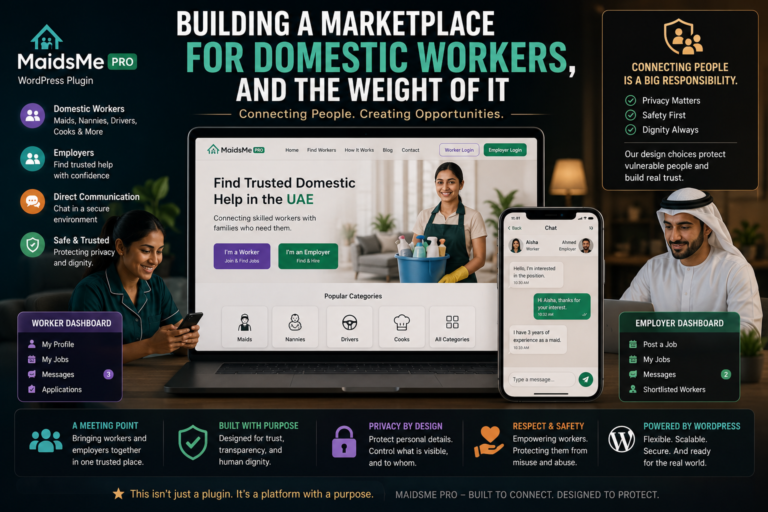
A marketplace where workers register through profession-shaped dynamic forms, profiles wait as pending_approval until a human approves them, and only approved_visible rows ever reach a public query. Employers browse without accounts and hire through a Hire Now form that auto-references the chosen worker, never their phone, into an inquiries queue the admin works through statuses. Underneath, seven tables owning one concern each, key-value profile storage that survives field changes, dbDelta migrations behind a version option, encrypted phone numbers readable only inside capability-checked screens, and dated JSON exports before any table died. On top, a rationed glassmorphism surface with transform-only motion, because the first trust signal is visual.
The judgment lessons, ranked honestly
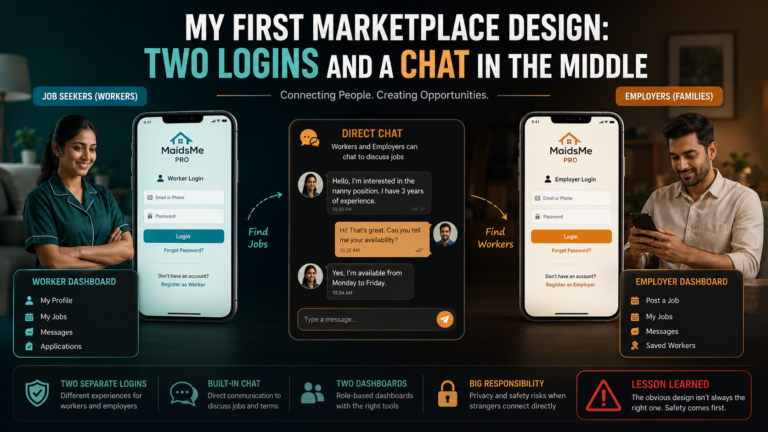
The teardown outranks everything. Deleting the working two-login system and its chat, half of version one, because walking the employer’s real need proved it was scaffolding, taught me that the courage to delete comes from counting, steps in the user’s walk, surfaces to maintain, features contradicting the core promise. Second, chosen friction, the approval gate is slower on purpose, and knowing which friction is a feature rather than a bug is a judgment no framework makes for you. Third, architecture as ethics, the phone-number rule was only real because it lived in the SELECT lists, the auto-fill, and encrypted storage, privacy in a template if-statement is a suggestion. And fourth, schema as design document, by the end I designed in tables first and screens second, and the code got simpler every time I did.
A few things people ask me about this
What was technically hardest? The dynamic field system, flexibility moves errors from the compiler to configuration, and building the validation and JSON export that made admin-shaped forms safe took longer than any fixed form would have. Worth it the first time a profession was added without a deployment.
Would you build a marketplace this admin-mediated again? For this population, without hesitation. For commodity marketplaces, no, mediation costs speed, and speed is what commodity users want. The design question is always who is being protected and from what.
What carried forward from earlier projects? The whole limo kit, the AJAX-and-nonce spine, class-per-job structure, the debug workflow, plus the deletion habits from the video tool. Projects compound, this one spent that inheritance on judgment problems.
Where this leads
After building platforms for other people’s businesses, the next builds were for my own, rate-tracking websites where the product is trustworthy numbers and the customer is a search engine’s idea of quality. Different stakes, different walls, starting with a gold and silver rates site for Pakistan, and a bug that taught me what fake data costs. That story is next.